
Medically reviewed by Dr. Walter Kostrzewski, DMD
Dr. Kostrzewski has more than two decades of experience in dentistry and reviews the dental information published by ACE Dental Resource.
Facelift dentures is a term sometimes used to describe dentures designed with particular attention to facial support, lip position, appearance, and the way the dentures function with the muscles around the mouth. The name can sound as though a denture can perform a surgical facelift, but that is not what dentures do.
In practical terms, the goal is to replace missing teeth while restoring appropriate support to the lips and lower face. When teeth have been lost, the supporting structures of the mouth change over time, and a well-designed denture can change the way the lips and surrounding soft tissues are supported.
This distinction matters. Modern research using three-dimensional facial scanning has demonstrated measurable changes in facial soft tissues after complete-denture treatment, particularly around the lips and lower third of the face. At the same time, dentures do not simply return an edentulous face to exactly the same proportions as a person with natural teeth.

What Are Facelift Dentures?
“Facelift dentures” is not a single standardized type of denture recognized in the same way as terms such as complete dentures, partial dentures, or implant-supported dentures. It is a descriptive term that has been used in dentistry to emphasize the relationship between denture design, facial appearance, and support of the tissues around the mouth.
The appearance of a denture depends on much more than the artificial teeth themselves. Tooth position, the shape and thickness of the denture base, lip support, bite relationship, facial proportions, and the condition of the underlying tissues all influence the final result.
For a patient who has lost many or all of their teeth, the objective is therefore not simply to “put teeth back.” A dentist and dental laboratory also have to create a prosthesis that is comfortable, functional, stable, and appropriate for the individual’s facial features.
What Are Strickland Facelift Dentures?
Strickland Facelift Dentures™ is a branded term associated with a denture approach that emphasizes facial appearance, denture fit, and neuromuscular concepts. The older material on this page described the treatment as an alternative to conventional dentures and associated it with improved facial support.
It is useful to separate the brand name from the broader dental evidence. Research does support the fact that complete dentures can change lip support and other measurable facial soft-tissue dimensions. That evidence does not establish that a particular branded denture system produces the equivalent of a surgical facelift or prevents normal post-extraction bone resorption.
Patients considering a branded denture system should ask which specific clinical features are being proposed, what evidence supports them, and how the treatment differs from a well-designed conventional or implant-supported denture.
Why Tooth Loss Can Change Facial Appearance
Natural teeth and their supporting tissues contribute to the shape of the lower face. After teeth are lost, the alveolar bone that once surrounded the tooth roots undergoes remodeling and resorption. The amount and pattern of this change vary considerably from one person to another.
Edentulism can also be associated with changes in the height and proportions of the lower face. Three-dimensional studies have found measurable differences in facial dimensions in people without natural teeth, with many of the changes concentrated in the middle and lower portions of the face.
This is one reason an older, poorly fitting denture can sometimes make a person feel that their face has become less supported. The issue is not simply age or skin laxity. Changes in the jaws, denture fit, tooth position, and the soft tissues around the mouth can all contribute.
How Dentures Affect the Lips and Facial Soft Tissues
A properly made complete denture provides a new supporting surface for the lips and cheeks. Its effect can be measured rather than merely observed.
A 2026 clinical study using 3D facial scans found that complete dentures produced consistent changes in perioral soft-tissue support, including increased upper-lip projection and a change in the nasolabial angle. Earlier 3D research has similarly found significant changes in the volume and position of tissues around the mouth after complete-denture treatment.
These findings help explain why a well-designed denture can make the lower face look more supported. They do not mean that every patient will experience the same cosmetic change. Facial anatomy, the amount of bone loss, the position of the artificial teeth, the denture base, muscle activity, and the patient’s existing facial proportions all matter.
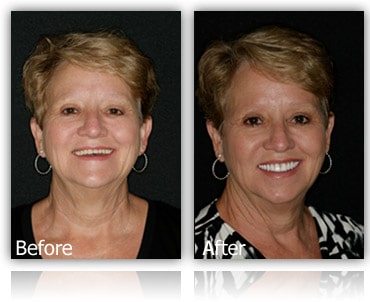
Can Dentures Make the Face Look Younger?
Sometimes they can make a noticeable difference in facial appearance, particularly when missing teeth and poorly supported lips have contributed to a collapsed or shortened lower facial appearance. But “younger-looking” is not a predictable medical outcome of wearing dentures, and a denture should not be presented as a substitute for a facelift.
The more accurate way to describe the effect is restoration of dental and perioral support. When tooth position and the vertical relationship between the upper and lower jaws are appropriate, the lips may receive better support and the proportions of the lower face may improve.
Research comparing edentulous patients before and after complete-denture rehabilitation has found that dentures can move facial measurements closer to those seen in people with natural teeth. However, measurable differences can remain. In other words, dentures can restore facial support without reproducing a natural dentition perfectly.
The Importance of Denture Design
Facial appearance is closely connected to denture design. Important considerations include the position of the artificial teeth, the contour of the denture base, lip support, occlusion, and the vertical dimension of the restored bite.
The occlusal vertical dimension is the facial height established when the upper and lower teeth contact. It is important for function, speech, comfort, and appearance. There is no single measurement that accurately determines the ideal vertical dimension for every patient. A review of the evidence recommends using a combination of clinical methods rather than relying on one measurement alone.
Too little support or an inappropriate vertical relationship can contribute to an unsatisfactory appearance. Too much support can also look unnatural and may affect comfort or function. This is why individualized assessment is more important than simply choosing a denture marketed under a particular name.
What About “Neuromuscular” Dentures?
Some dentists and denture systems use neuromuscular concepts when planning treatment. These approaches place particular emphasis on the relationship between the teeth, jaw position, and muscles involved in chewing and facial movement.
There are legitimate clinical reasons to consider muscle function and jaw position when designing dentures. However, patients should be cautious about broad claims that a particular denture system can stop jaw-bone resorption, permanently prevent facial sagging, or provide the equivalent of a surgical facelift. The available evidence supports the ability of dentures to alter facial soft-tissue support; it does not justify treating every marketing claim associated with the term “facelift dentures” as an established clinical fact.
Facelift Dentures vs. Conventional Complete Dentures
| Consideration | What matters clinically |
|---|---|
| Facial appearance | Tooth position, lip support, denture contours, facial proportions, and the patient’s anatomy all influence appearance. |
| Comfort | The denture must fit the supporting tissues appropriately and allow normal function without persistent sore spots. |
| Stability | Jaw anatomy, ridge shape, saliva, muscle activity, and denture design all affect how stable a removable denture feels. |
| Bite and facial height | The vertical relationship between the upper and lower teeth must be established individually rather than by a single universal measurement. |
| Bone changes | Tooth loss is followed by remodeling and resorption of the residual ridge. Conventional dentures do not recreate a natural tooth root. |
Do Dentures Stop Jaw-Bone Loss?
No. This is an important distinction.
After a tooth is removed, the bone that supported its root no longer receives the same functional stimulation and undergoes remodeling. Complete dentures can restore chewing function and facial support, but they do not reproduce the biological function of a natural tooth root.
Implant treatment is different because an implant is placed in the jaw and can provide a form of root replacement. This does not mean implants completely prevent every type of bone change, but they can change the mechanical environment compared with a conventional removable denture.
For this reason, a claim that a particular removable denture “stimulates the bone” enough to prevent normal post-extraction resorption should be treated cautiously.
Facelift Dentures vs. Implant-Supported Dentures
| Feature | Conventional complete denture | Implant-supported denture |
|---|---|---|
| Removable | Yes | Usually yes for overdentures; some implant restorations are fixed |
| Uses dental implants | No | Yes |
| Facial support | Can provide lip and perioral support through the denture | Can provide denture support while implants improve retention and stability |
| Bone involvement | Does not replace the missing tooth roots | Implants are placed within the jaw and function as artificial tooth roots |
| Cost and treatment complexity | Generally less complex | Usually more involved and may require surgery and additional treatment |
Who Might Benefit From This Type of Denture Treatment?
A person who has lost all or most of their teeth may benefit from a carefully planned complete or partial denture, particularly when facial appearance and lip support are important concerns. The right treatment depends on the condition of the remaining teeth, gums, jawbone, general oral health, expectations, and budget.
Someone who already wears dentures and notices that they have become loose, uncomfortable, difficult to chew with, or unattractive should have them evaluated rather than assuming that a particular “facelift” denture is automatically the answer.
Questions to Ask Your Dentist
- How will the new denture support my lips and cheeks?
- How will you determine the appropriate vertical dimension for my bite?
- What changes should I realistically expect in my facial appearance?
- Would a conventional denture, partial denture, or implant-supported option be appropriate for me?
- How much bone loss has already occurred?
- Will I need extractions or other treatment before the denture is made?
- How will the fit be checked and adjusted after delivery?
- What are the expected maintenance and replacement requirements?
How Much Do Facelift Dentures Cost?
There is no standardized national price for “facelift dentures,” because the term does not describe one universally defined prosthesis. As a current U.S. benchmark, 2026 national data from CareCredit reports traditional removable dentures at an average of $2,022, with a reported range of $1,493 to $3,309. Premium removable dentures average $6,703, with a reported range of $4,484 to $11,018. Implant-supported dentures are substantially more variable; the same source reports an average of $4,093 per implant. These are benchmarks rather than individual treatment quotes, and actual fees vary by location, materials, laboratory costs, preparatory treatment and the number of implants required. See CareCredit’s 2026 denture cost data. The term describes an approach to denture design rather than one standardized treatment with a universal fee.
The final cost can depend on whether the patient needs a complete or partial denture, the materials used, the laboratory involved, the dentist’s fees, extractions or other preparatory treatment, the complexity of the case, and whether dental implants are included.
Patients comparing prices should therefore compare the complete treatment plan, not just the advertised price of the denture itself.
How Long Do Dentures Last?
Dentures do not last forever. The mouth changes over time as the supporting tissues and residual ridges remodel, and the denture materials also undergo wear.
A denture can sometimes remain serviceable for years, but the appropriate time for replacement or adjustment varies from patient to patient. Regular dental examinations can identify problems with fit, wear, oral tissues, or changes in the remaining teeth before they become more difficult to manage.
The Bottom Line
Facelift dentures are best understood as a term associated with dentures designed with particular attention to facial support and appearance—not as a nonsurgical facelift.
Modern 3D research provides good evidence that complete dentures can produce measurable changes in the soft tissues around the mouth and lower face. The size and direction of those changes vary between individuals, and dentures do not perfectly reproduce the facial proportions of a natural dentition.
The most important factor is therefore not the label on the denture. It is the quality of the diagnosis, treatment planning, tooth arrangement, fit, facial support, bite relationship, and follow-up. A dentist can evaluate these factors and explain whether conventional dentures, partial dentures, or an implant-supported option makes sense for your situation.
Research and Sources
The article has been reviewed against peer-reviewed dental literature and current clinical reference material. Key sources include:
- López Hernández E, Alvarez A, Abou-Ayash S, Att W. Effect of Complete Dentures on Facial Soft Tissue Volume: A 3D Comparative Study. International Journal of Prosthodontics. 2022;35(2):208–218. PubMed.
- Pucciarelli MGR et al. Quantifying the facial proportions in edentulous individuals before and after rehabilitation with complete dentures compared with dentate individuals: A 3D stereophotogrammetry study. Journal of Prosthetic Dentistry. 2024;131(4):697–704. PubMed.
- Alhajj MN et al. Determination of occlusal vertical dimension for complete dentures patients: an updated review. Journal of Oral Rehabilitation. 2017;44(11):896–907. PubMed.
- Facial soft tissue surface changes following complete denture treatment: A comprehensive 3D analysis. Journal of Prosthetic Dentistry. 2026. PubMed.
- Occlusal Vertical Dimension: Best Evidence Consensus Statement. Journal of Prosthodontics. 2021. PubMed.
Further Reading
For readers interested in the research behind facial changes after denture treatment, see the published studies on 3D facial soft-tissue changes following complete-denture treatment, facial proportions before and after complete dentures, and determination of occlusal vertical dimension for complete dentures.
Editorial note: This article is intended for general educational purposes. Denture treatment is individualized, and a dental examination is necessary to determine the most appropriate option for a particular patient.