
Dark or brown areas of the gums can be completely benign, but pigmentation has several possible causes. When a patient wants treatment for appearance, the procedure is usually called gingival depigmentation rather than simply “gum bleaching.”
Dr. Kostrzewski has more than two decades of experience in dentistry and reviews the dental information published by ACE Dental Resource.
The first step is determining why the gums look darker. Healthy physiologic melanin pigmentation is different from pigmentation associated with tobacco, medication, inflammation, restorations or another oral condition. A 2026 systematic review emphasizes that gingival pigmentation has diverse causes and requires appropriate clinical assessment. [1]
What causes dark gums?
| Possible cause | What it means |
|---|---|
| Physiologic melanin pigmentation | Natural pigmentation can vary between individuals and may be evenly distributed. |
| Smoking or tobacco | Can contribute to oral pigmentation, including smoker’s melanosis. |
| Medications | Some medicines can produce oral or gingival pigmentation. |
| Inflammation or gum disease | Needs periodontal assessment rather than cosmetic depigmentation alone. |
| Restorations or dental materials | Can sometimes produce localized dark discoloration. |
| Other oral or systemic conditions | May require further evaluation before cosmetic treatment. |
Not every dark area is caused by melanin. A new, changing, irregular or localized pigmented lesion should be examined rather than assumed to be cosmetic. The 2026 review highlights the importance of screening for potentially significant lesions. [1]
What is gingival depigmentation?
Gingival depigmentation is a procedure intended to reduce visible melanin pigmentation of the gums. It is generally elective when the pigmentation is physiologic and the gums are otherwise healthy.
How does laser gum depigmentation work?
A dental laser can ablate superficial pigmented gingival tissue. Other approaches include scalpel techniques and electrosurgery. Evidence does not establish one method as universally best for every patient.
A systematic review and meta-analysis found that laser treatment and surgical stripping can both produce depigmentation, with differences in postoperative pain and recurrence depending on technique and follow-up. [2] Another review found inconsistent evidence for which laser type or protocol is optimal. [3]
Is gum bleaching painful?
Discomfort varies with the technique and extent of treatment. Local anesthesia may be used, and soreness can occur while the treated tissue heals. The systematic review found less postoperative pain with laser ablation than surgical stripping in the studies analyzed, but individual experience varies. [2]
How long does healing take?
Healing depends on the area treated, technique and individual response. Your dentist should provide instructions for oral hygiene, diet and pain control and explain when a review is needed.
Will the pigmentation come back?
It can. Depigmentation does not necessarily eliminate the biological tendency to produce melanin. Repigmentation has been reported after different techniques, and recurrence varies among studies. [2] Claims that one treatment permanently produces pink gums for decades or for life should therefore be treated cautiously.
Who may be a candidate?
- Patients with physiologic gingival pigmentation who are unhappy with its appearance.
- Patients with healthy gums or gum disease that has been treated first.
- Patients whose pigmentation has been evaluated and does not require medical investigation.
Active gum disease, unexplained pigmentation or a changing lesion should be addressed before elective depigmentation.
Can smoking affect gum pigmentation?
Yes. Tobacco exposure can contribute to oral pigmentation. Stopping tobacco is important for oral health regardless of whether cosmetic depigmentation is pursued.
Does gum depigmentation treat gum disease?
No. Depigmentation is an aesthetic procedure and does not replace periodontal treatment for gum disease or periodontitis.
What are the risks?
- Pain or sensitivity during healing
- Bleeding or swelling
- Delayed healing or infection
- Uneven pigmentation or gum contour
- Repigmentation
- Changes in gum appearance
What about Waterlase or another specific laser?
The original page promoted Waterlase as the modern approach. That is too broad. Different laser systems and non-laser methods have been studied, and current evidence does not justify treating one commercial system as universally superior. The important questions are diagnosis, indication, technique, operator experience and expected recurrence.
How much does gum depigmentation cost?
There is no dependable universal price. Fees depend on the area treated, technique, number of visits, clinician and location. Ask for a written estimate after examination.
Historical information from the original article
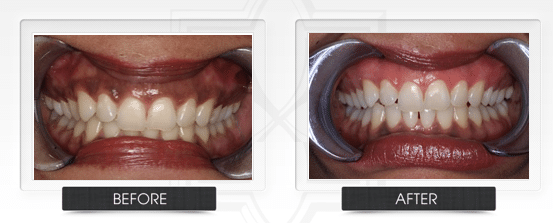
The original page featured a case image courtesy of Dr. Tom Hedge. It is preserved for historical continuity, but should not be interpreted as a current endorsement or evidence of an ongoing affiliation.

Questions to ask before treatment
- What is causing my gum pigmentation?
- Does it need further examination?
- Are my gums healthy enough for elective treatment?
- Which technique do you recommend and why?
- What are the chances of repigmentation?
- What will healing involve?
- What happens if pigmentation returns?
- What is included in the total cost?
Related ACE Dental Guides
Gum Disease · Cosmetic Dentistry: The Art & Science · Cosmetic Dentistry FAQs · Cosmetic Dentistry Cost Factors
Bottom Line
Dark gums are not automatically unhealthy, and cosmetic depigmentation should begin with diagnosis rather than a promise of “pink gums.” Laser and surgical techniques can reduce physiologic pigmentation, but recurrence is possible and evidence does not establish one method as universally superior.
Research and Sources
- Carra MC, et al. Management of Non-Plaque-Induced Gingival Conditions: A Systematic Review—Part 2. Journal of Clinical Periodontology. 2026. PubMed.
- Gul M, et al. Most effective method for the management of physiologic gingival hyperpigmentation: A systematic review and meta-analysis. 2019. PubMed.
- Bakhshi M, et al. Laser-Assisted Depigmentation—An Introspection of the Science, Techniques, and Perceptions. 2020. PubMed.
Editorial note: Gingival pigmentation has multiple possible causes. This article provides general educational information and is not a substitute for examination or diagnosis by a licensed dental professional.